How to Plan a Motorhome Route That Avoids Narrow Roads and Low Bridges
The best part of touring is the freedom to go wherever the road takes you. The worst part is that sinking feeling when the road turns out to be a single-track lane with a stone wall on either side, or a low bridge appears ahead with a height sign that is smaller than your van.
Standard sat navs do not understand your vehicle. They route a 3.5-tonne motorhome the same way they route a hatchback, and that is how drivers end up reversing half a mile down a Cornish lane or stopping dead in front of a 3.2 m bridge they cannot get under.
This guide walks you through how to plan a motorhome route that avoids narrow roads and low bridges, step by step, so you arrive feeling ready instead of relieved.
Step 1: Know your vehicle's real dimensions
You cannot plan around restrictions until you know exactly what you are working with. Before any trip, write down these numbers and keep them to hand:
- Overall height, including roof boxes, aerials and solar panels
- Overall width, including mirrors
- Overall length, including any tow bar or bike rack
- Gross weight, for bridges and weight-limited routes
Measure these yourself rather than trusting the brochure. A roof vent or an aftermarket awning can add centimetres that make the difference between clearing a bridge and stopping traffic.
Step 2: Identify the obstacles that actually stop a motorhome
Not every restriction applies to you, but these are the ones that catch touring drivers most often.
Low bridges
Bridge heights across the UK vary enormously, from well-signed trunk-road bridges to rural crossings with a 15-foot (4.6 m) or even lower limit. A vehicle-aware system checks every bridge on the route against your height and simply will not send you under one you cannot clear.
Width restrictions
Width limits are common in older towns, on weight-restricted lanes, and through historic centres. If your outfit is 2.4 m wide with the mirrors folded, a 2.1 m width restriction is a hard no - and it is usually signposted too late to turn around comfortably.
Single-track and narrow rural lanes
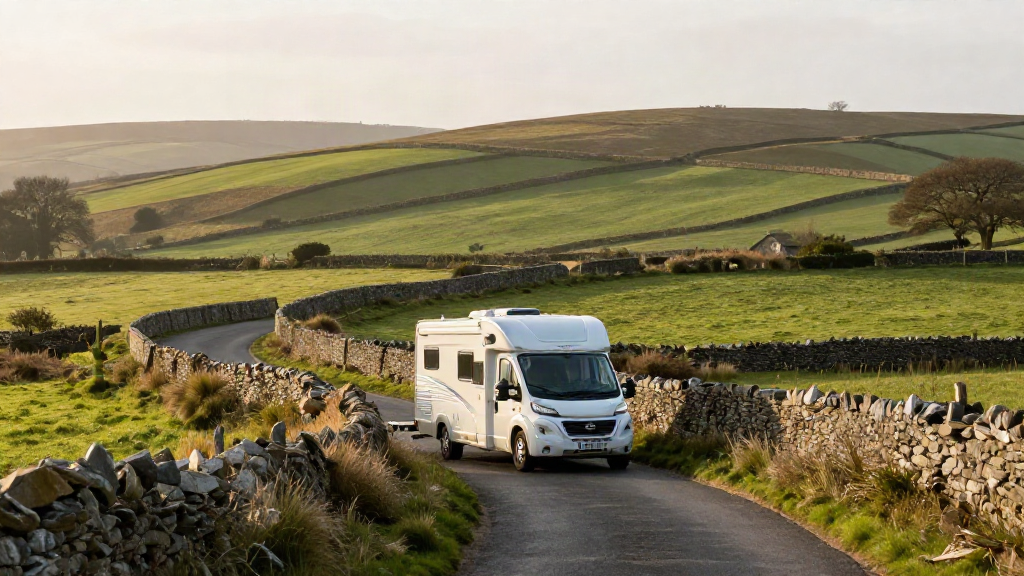
These are the roads that look fine on a map and turn into a tightrope in real life. Narrow lanes with passing places are the single biggest source of stress for motorhome drivers, especially when towing.
Weight and low-emission zones
Weight-limited bridges and town-centre restrictions can catch heavier outfits. Knowing your gross weight keeps you clear of both.
Step 3: Plan with a sat nav that understands your vehicle
This is where a purpose-built app changes the whole experience. Instead of pretending to be a car, you tell the app what you are driving and it plans accordingly.
With Motorhome & Caravan Sat Nav, you enter your vehicle's dimensions once - height, width, weight and length - and every route from then on is calculated around them. Bridge heights and width restrictions are checked automatically, so the app avoids the low bridges and tight lanes that a standard sat nav would happily send you down.
A few practical habits make it even smoother:
- Enter your dimensions accurately and update them if you add a bike rack or roof box
- Review the route overview before you set off, not at the first junction
- Trust the vehicle-aware warnings - if the app flags a restriction, believe it
- Use live traffic so you are not rerouted onto a narrow alternative at the last minute
Because the app works with live traffic and Apple CarPlay, your focused route sits right on the dashboard screen, where it belongs.
Step 4: Find places to stay that can actually take your outfit
Planning the route is only half the job. The other half is knowing the destination will fit you.
The app includes 6,000+ UK campsites, so you can find your next stop and navigate straight to it - no more arriving at a site entrance that is too narrow, or a pitch access road that cannot take your length. You plan the approach and the stop in one place, which means fewer surprises on the last mile.
Step 5: Build in breathing room
Even the best-planned route benefits from a little slack. Motorhomes travel at a different pace, and rural roads take longer than the map suggests. Add buffer time for the narrow sections, plan your stops before you need them, and you will spend less time rushing and more time enjoying the view.
Why vehicle-aware routing removes the worry
The real shift is psychological. When your navigation already knows your height, width and weight, you stop scanning every bridge sign with your heart in your throat. You stop second-guessing whether that lane is wide enough. You just drive, confident that the route in front of you was built for your vehicle.
Touring should feel like freedom, not a constant calculation. Vehicle-aware routing hands the calculation back to the app.
Try it before you commit
Motorhome & Caravan Sat Nav is free for 7 days, then GBP 3.99/month on iPhone and iPad. There is no better way to test it than on your next trip: enter your vehicle's dimensions, let the app plan the route, and see how different the drive feels when narrow roads and low bridges are handled for you.
Plan the route, trust the guidance, and arrive feeling ready.