Caravan Sat Nav App UK: How It Differs From a Standard Sat Nav
Your car's sat nav is good at one thing: getting a car from A to B. Hook up a caravan and that assumption quietly falls apart. The fastest route it picks may run under a low bridge, squeeze down a lane that was never built for a 2.4m-wide outfit, or send you into a village where you simply cannot turn around.
A caravan sat nav app for the UK works from a different starting point. Instead of assuming "car", it asks what you are actually driving and towing, then plans around that. This guide compares the two honestly, so you can judge whether a vehicle-aware app is worth swapping in before your next tour.
Why a standard sat nav gets caravans into trouble
Standard sat navs optimise for speed in a car. They know about road types and traffic, but they do not know your caravan exists. That gap shows up in three predictable ways:
- Height and width restrictions. Low bridges, narrow archways and tight town-centre streets are invisible to a device that assumes a standard car footprint.
- Weight limits. Roads with weight restrictions are legal no-go areas for heavier outfits, but a car sat nav will happily route you down them.
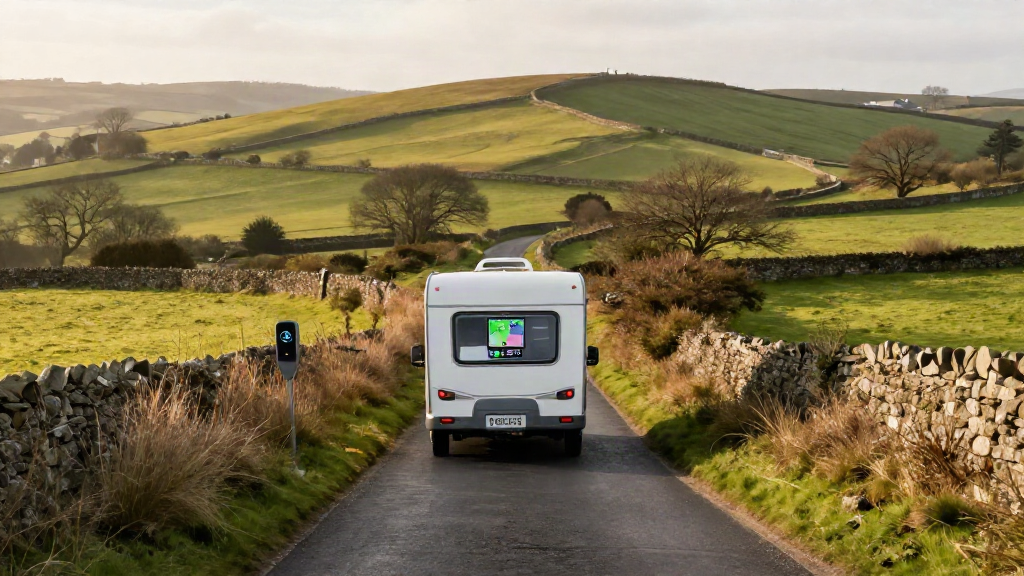
- Narrow rural roads. The shortest line between two points is often a single-track lane with no passing places and no room to reverse a caravan.
The result is the familiar touring stress: a route that looks fine on screen until the moment you meet it in person.
What a caravan sat nav app does differently
A UK touring app such as Motorhome & Caravan Sat Nav starts by asking for your vehicle's dimensions - height, width, weight and, where relevant, length. Those numbers are not a gimmick. They become the rules the routing engine must obey.
From there:
- Vehicle-aware routes. The app avoids low bridges, width-restricted lanes and roads that cannot take your weight, so the route it gives you is one you can actually drive.
- Clear restrictions on the map. You can see the constraint, not just be told about it, so a diversion decision is yours to make with information in front of you.
- Live traffic. Jams and closures are factored in, which matters more when turning around is not an option.
- Apple CarPlay. Directions appear on your car's own screen, so you are not balancing a phone while towing.
In short, a standard sat nav answers "what is the quickest road?" A caravan sat nav app answers "what is the quickest road I can safely take this outfit down?"
Side by side: standard sat nav vs caravan sat nav app
| Question | Standard car sat nav | Caravan sat nav app (UK) |
|---|---|---|
| Does it know your vehicle dimensions? | No | Yes - height, width, weight |
| Does it avoid low bridges? | Not reliably | Yes, built into routing |
| Does it respect weight limits? | Rarely | Yes |
| Does it warn about narrow roads? | No | Yes, with restrictions shown |
| Can it find caravan-friendly campsites? | No | Yes - 6,000+ UK campsites |
| Works with Apple CarPlay? | Sometimes | Yes |
| Cost model | Often a paid device or map update | Free for 7 days, then GBP 3.99/month |
The pattern is simple. A general sat nav is a map with a fastest-route rule. A caravan sat nav app layers your vehicle's real limits on top of that map.
Finding somewhere to stay, not just a route
Half the job of touring is knowing where you can stop. A standard sat nav will get you to a postcode, but it has no idea whether the site can take your outfit or whether the approach road suits a caravan.
A purpose-built touring app folds that in. With 6,000+ UK campsites, you can plan the next stop alongside the route to reach it - so arrival day stops being a gamble on a narrow access lane and starts being the calm end to a good drive.
Where a phone app fits best - and where it doesn't
It is worth being straight about this. A phone-based app is not always the right answer for everyone.
It fits best if you:
- want your vehicle's dimensions respected without buying a dedicated caravan-specific device;
- already use Apple CarPlay and prefer directions on the car screen;
- want to find suitable UK campsites in the same place you plan your route;
- prefer to try before committing.
It may suit you less if you tour entirely off-grid with no signal, or you specifically want a standalone hardware unit. For most UK touring - sites, A-roads, towns and the odd tricky lane - a well-built app covers the job and updates faster than a fixed device.
What to check before you commit
If you are weighing up a caravan sat nav app against the sat nav already in your car, test these three things on a real route:
- Vehicle setup. Enter your height, width and weight, then check the app avoids a restriction your car sat nav would have taken you through.
- The approach. Plan a route to a campsite you know is awkward and see whether the app sends you a sensible way in.
- The screen. Confirm it runs on Apple CarPlay so directions sit where you already look.
Motorhome & Caravan Sat Nav is free for 7 days, then GBP 3.99 a month on iPhone and iPad. That gives you real UK routes to judge it on - not a showroom demo.
The bottom line
A standard sat nav is built for cars. A caravan is not a car, and the difference shows up at exactly the wrong moments: the low bridge, the tight lane, the site entrance you cannot turn into.
A caravan sat nav app for the UK starts from your vehicle's real dimensions and plans within them, then helps you find a place to stay that will actually take your outfit. If you want to arrive feeling ready rather than relieved, that is the change worth making - and the free trial is where to start.