Most owners start with the sat nav already on their phone. It has served you well in the car, so it seems reasonable to assume it will serve you just as well with a caravan on the back. Then you meet your first narrow lane, or a low bridge you did not see coming, and the assumption starts to fray.
This is not really a story about one app being better than another. It is a story about what a sat nav is being asked to plan for. A car sat nav plans for a car. A caravan sat nav app plans for your outfit. On UK roads, that difference shows up quickly.
Why a standard sat nav struggles with your outfit
A standard sat nav routes on one assumption: the vehicle is a car. Roughly 1.8 metres wide, under 2 metres tall, a couple of tonnes at most. Every decision it makes - which lane, which junction, which shortcut - is built on that shape.
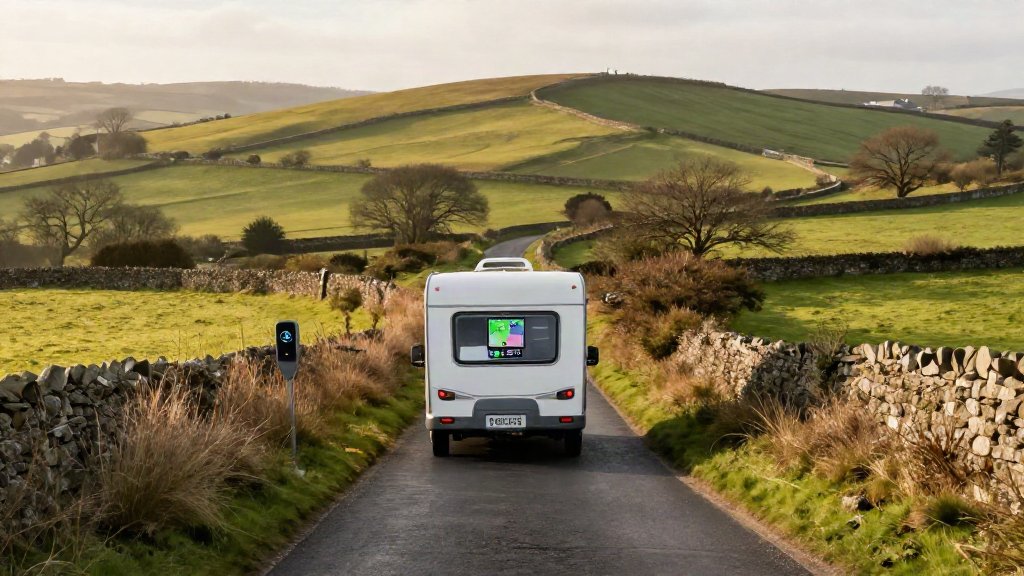
Your motorhome or caravan is a different shape. Height, width, weight and length all change what a road will accept. A route that is perfectly sensible for a hatchback can be genuinely impossible for a 3.2 metre tall motorhome, or deeply uncomfortable for a caravan on a single-track lane with high hedges and no passing place.
Standard apps rarely know this. They will happily send you down a road with a 2.9 metre height restriction, or along a weight-limited bridge, because nothing in their routing model objects to it.
What "vehicle-aware" actually means
A vehicle-aware app asks you one question a car sat nav never asks: what are you driving?
You enter your vehicle's dimensions once - height, width, length, weight - and the app routes accordingly. Those figures become a constraint on the map, not a footnote. Roads that cannot take your outfit are filtered out or avoided before you are on them, rather than discovered by you at the wheel with a queue forming behind.
That is the whole idea. It is simple, and it is the single biggest reason an owner switches. In practice it changes four things.
1. Height and width restrictions become a routing input
Low bridges, height barriers, width restrictions and narrow lanes stop being surprises. Instead of a warning that arrives too late, they are treated as roads your vehicle cannot use. For a caravan sat nav app in the UK this matters most in exactly the places touring takes you - rural A and B roads, historic town centres, park-and-ride entrances and country lanes that look inviting on the screen.
2. Weight and length shape the route, not just the warning
Weight limits on bridges and some rural lanes are easy to overlook, and towing makes reversing out of a bad call far harder. When weight and length are part of the routing model, the app steers you toward roads that can take the outfit and away from the ones that cannot. The route may be a few minutes longer. It is also the route you actually want.
3. The last mile stops being guesswork
For most sat navs the journey ends at a postcode. For a touring outfit, the last mile is often the hard part: a tight site entrance, a narrow access lane, a turn you would rather not take with a caravan behind you. A touring-aware app is built around where you are actually going, and it carries more than 6,000 UK campsites, so you can plan the stop as part of the drive rather than as a separate search on a phone balanced on the dashboard.
4. Day-to-day driving stays familiar
This is not a compromise on the basics. Live traffic re-routes you around jams. Apple CarPlay keeps the map on the screen you already use, where you can glance at it safely. The parts of a sat nav you rely on every day still work exactly as you expect. What changes is what sits underneath them: a routing engine that knows your vehicle.
What a standard sat nav still does well
It is worth being fair about this. A standard sat nav is fine if you are touring in a car-sized campervan, staying on motorways and main A roads, and never quite leaving the corridor of roads a car can use. It is cheaper, or already included, and it does the simple job well.
The trade-off appears the moment your outfit stops being car-shaped, or your route leaves the trunk roads. That is where the fit question really sits - not which app is best in the abstract, but whether your journeys are the kind that a car-shaped route can serve.
How to judge fit before you commit
You do not need to take anyone's word for it, and you should not have to. The sensible way to test this is on your own roads, with your own dimensions entered:
- Enter your vehicle's height, width, length and weight.
- Plan a route you know well, ideally one with a restriction on it, and see how it differs from your usual sat nav.
- Plan a real trip end to end, including the campsite, rather than a postcode in isolation.
The app is free for 7 days, then £3.99 a month on iPhone and iPad, so you can run that test across several real journeys before deciding anything.
The short answer
A standard sat nav answers the question "how do I get there?". A vehicle-aware caravan sat nav app for the UK answers a more specific question: "how do I get there in this outfit, and where can I stay when I arrive?"
If you drive a motorhome, caravan or campervan on UK roads, that second question is the one that matters. Enter your vehicle's dimensions, plan a route you know, and see the difference for yourself - ideally before your next narrow lane finds you first.